
Flint Directory Holdings by Era
Flint Public Library identifies R.L. Polk and Company directories for Flint and nearby communities from the 1890s to the present in its broad collection description. That is a useful starting range, not a promise that every annual volume is on the shelf. The public page does not publish a shelf-by-shelf list, publisher imprint list, or call numbers. Confirm the exact year with the library catalog or local-history staff before planning a visit. The early and later catalog leads below are useful targets, but gaps between them must remain gaps until a volume is checked.
| Collection | Years | Where Held | Access |
|---|---|---|---|
| R.L. Polk Flint and surrounding-community directories | 1890s to present, exact shelf years to verify | Flint Public Library Local History & Genealogy Room | Name and address arrangement; ask staff about each volume and reverse pages. |
| Early Flint city directory catalog leads | 1885; 1888 to 1889; 1892 to 1893 | FPL, catalog, or archival route | Verify publisher, physical availability, and readable pages before relying on a lead. |
| Mills Flint directory leads | 1894; 1897 to 1898; 1899 | Catalog, library, or licensed digital collection | Historic publisher leads, with image inspection needed for actual entry fields. |
| NARA census-support directory reference | 1929 to 1932 | National Archives reference and FPL cross-check | Verified federal reference run, especially useful beside the 1930 census. |
| Later Polk catalog examples | 1936 to 1939; 1941 to 1942; 1945 | FPL local history and licensed catalogs | Check for the specific volume rather than assuming every intervening year survives. |
Directories arranged by name or address form the core Flint city directory trail. Some volumes may carry occupation, initials, spouse-in-parentheses notation, business information, or owner and occupancy marks. Those details vary by year and publisher. A separate Flint reverse-directory title and a complete reverse-directory date run were not located in the inspected official sources.
Note: Treat each catalog year as a lead until the actual Flint volume and its front matter have been inspected.
Flint City Directory Year Leads
The Flint directory sequence has strong anchors without a complete public inventory. The 1885, 1888 to 1889, and 1892 to 1893 leads establish early targets. Mills examples appear for 1894, 1897 to 1898, and 1899. The National Archives reference confirms Flint directories for 1929 through 1932 in material supporting the 1930 census. Later examples for 1936, 1937, 1938, 1939, 1941, 1942, and 1945 should be requested by year, not treated as a continuous run.
A household can disappear from one Flint city directory for several reasons. A person may have moved, died, changed a name, been omitted, or appeared under an initial. Compare spellings, spouse or parent names, and the address section where available. Do not infer legal ownership from a listing. A directory is evidence that an entry appeared near a publication date, not proof of title or an exact move date.
For a recent, address-keyed trail, use the official records on the Flint street directory route rather than treating historic volumes as current resident records.
What Flint Directory Listings Reveal
The public library and National Archives pages describe Flint directory structure but did not expose a legible scanned Flint entry during research. That image-level gap matters. The inventory below is an expected set of fields to look for in the actual volume, not a claim that every Flint city directory prints every field. Photograph or note the abbreviation key before interpreting any marks. A symbol that changes by publisher or year should not be expanded from memory.
| Expected field | What to record from the page image |
|---|---|
| Name | Surname, given name, initials, and any spelling variant printed in that volume. |
| Household notation | Spouse in parentheses, widow notation, room or apartment detail, when printed. |
| Address | Street number and street name exactly as printed, including direction or abbreviation. |
| Work or business clue | Occupation, employer, business name, or business address only when the entry shows one. |
| Status mark | Owner, occupant, telephone, or other notation only after checking that volume's key. |
- Criss-cross directory
- An address-arranged portion of a directory that can lead from a house number and street to a listed name.
- Householder index
- A name-based arrangement that helps identify the person or household attached to an entry.
- Abbreviation key
- The volume's own guide to short forms and symbols. Keep a copy of it with entry notes because meanings can vary.
If a Flint city directory lacks a reverse section, use the street index, telephone books if staff can identify a run, tax evidence, plat evidence, or Sanborn maps. The local-history staff can help identify the right format. Exact Flint telephone-book and yearbook runs were not published on the inspected pages.
Flint Directory Room Research
The Flint Public Library Local History & Genealogy Room is on the lower level and focuses on Flint, Genesee County, and Michigan. Its collection began with a 1905 DAR gift and is described by the library as Michigan's second-largest open-stack genealogy collection. The room brings city directories together with local newspapers, census microfilm, maps, and staff assistance, which makes it a practical place to resolve a Flint city directory question that a web catalog cannot answer.
The library's local-history room details show the equipment and access channels available for Flint city directory work.
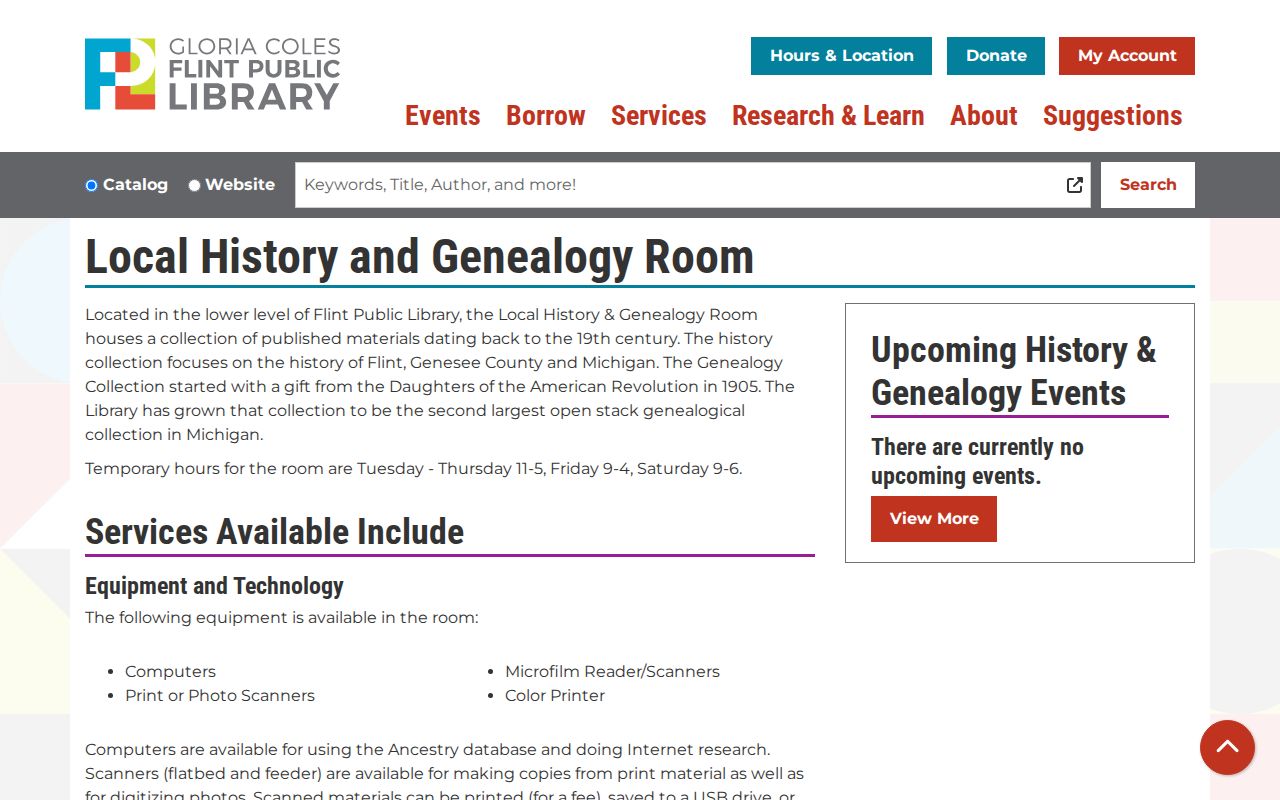
Microfilm readers and scanners, onsite Ancestry Library Edition, a color printer, USB or email delivery options, and staff help with fragile microfilm support a careful Flint search. A 30-minute Book an Expert appointment can help turn a surname or old street question into a directory, map, or deed plan. Special Collections is next door and staff retrieve materials there by request. The room page lists temporary hours of Tuesday through Thursday, 11 a.m. to 5 p.m.; Friday, 9 a.m. to 4 p.m.; and Saturday, 9 a.m. to 6 p.m. Verify hours before traveling.
Flint Directory Map Context
Use maps to test whether an old Flint address describes the same place as a modern parcel. The Library of Congress identifies Flint Sanborn editions from 1886, 1892, 1898, 1902, 1909, and 1914. The March 1898 item has 18 sheets. The 1914 edition has 102 sheets for the congested district. Sanborn sheets show lot outlines, street names, building shape and material coding, and pasted updates. They do not identify all occupants.
Start with the street form printed in the Flint city directory, locate the lot or building footprint on a map, then compare the legal description or a plat. A map can explain why a later address card does not match an older entry, but it cannot establish who lived there. FPL also identifies street maps, Genesee plat maps, 1971 Flint aerial photographs, and bird's-eye views as house-history aids. Flint is not completely covered by every Sanborn edition.
Note: Retain the old street spelling and number even when a map suggests a modern equivalent.
Flint Directory Archive Routes
When a directory year is missing or a name needs context, repository routes can add a different kind of evidence. The Genesee County Historical Society offers a county timeline, local stories, vintage photographs, Historian material, and an Ask Archivist contact path. Ask with a surname, street, collection type, and date. Its public page does not offer a complete names index, research-fee schedule, or detailed item-level holding list, so describe a request narrowly.
The Historical Society's public collection route is a useful lead for Flint directory context and local family questions.

The image reflects a repository starting point, not a searchable directory database. Its timeline, photos, stories, and archivist contact are most useful after the directory supplies a street, date, or family name.
The Library of Michigan Genesee guide points to county histories, newspapers, atlases, biographical works, cemetery references, and genealogy materials. Holdings dates describe the guide's resources and should not be read as a guarantee that every issue or book is digitized.
The Library of Michigan guide provides another Flint city directory research route beyond the local shelf.
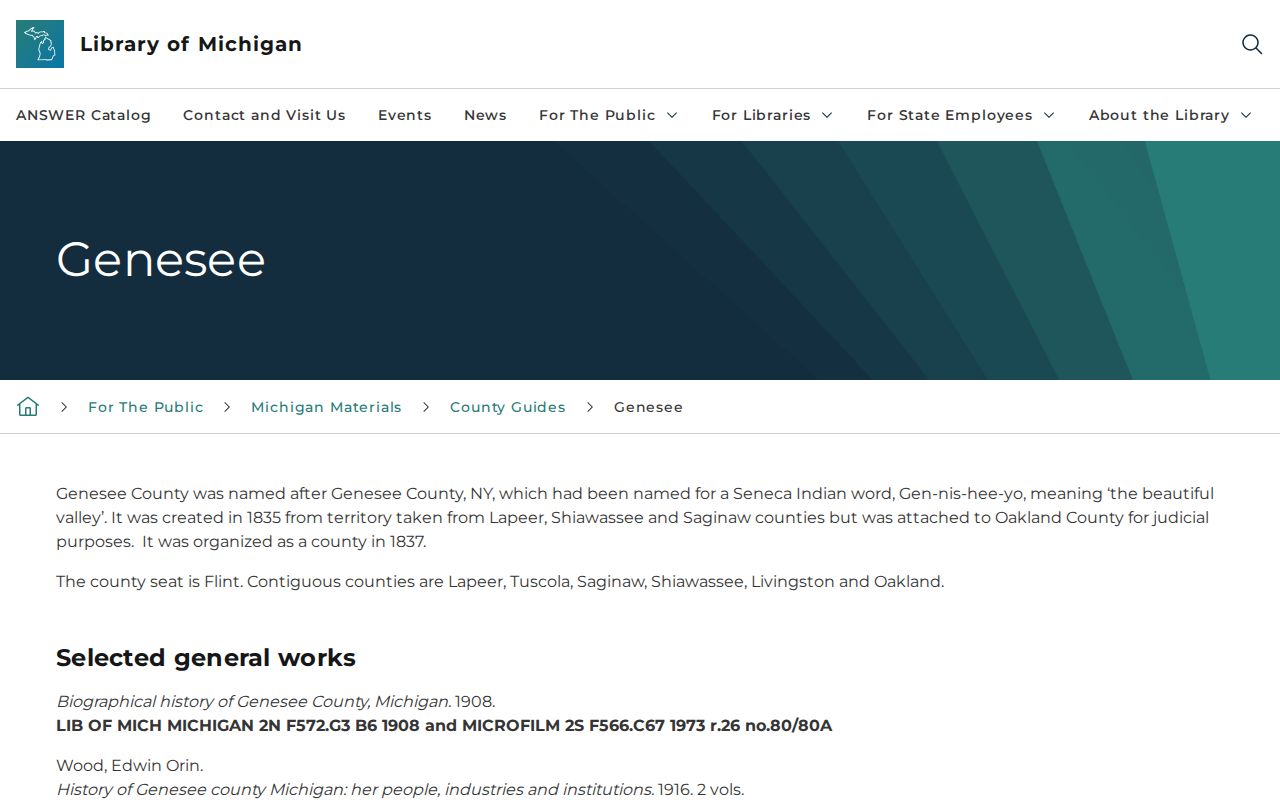
Use the guide to broaden a Flint name search with local histories, atlas context, or newspaper references, then confirm the item's actual access method with the holding institution.
For primary-source material, the UM-Flint Digital Archives holds the Genesee Historical Collection Center, open to all, with Flint and Genesee County documents. Its materials include student and community records, photographs, letters, papers, police and National Guard material, and descendants' donated photographs. Item-level access and privacy conditions still need checking.
UM-Flint's digital collections can extend a Flint city directory search into local primary sources.
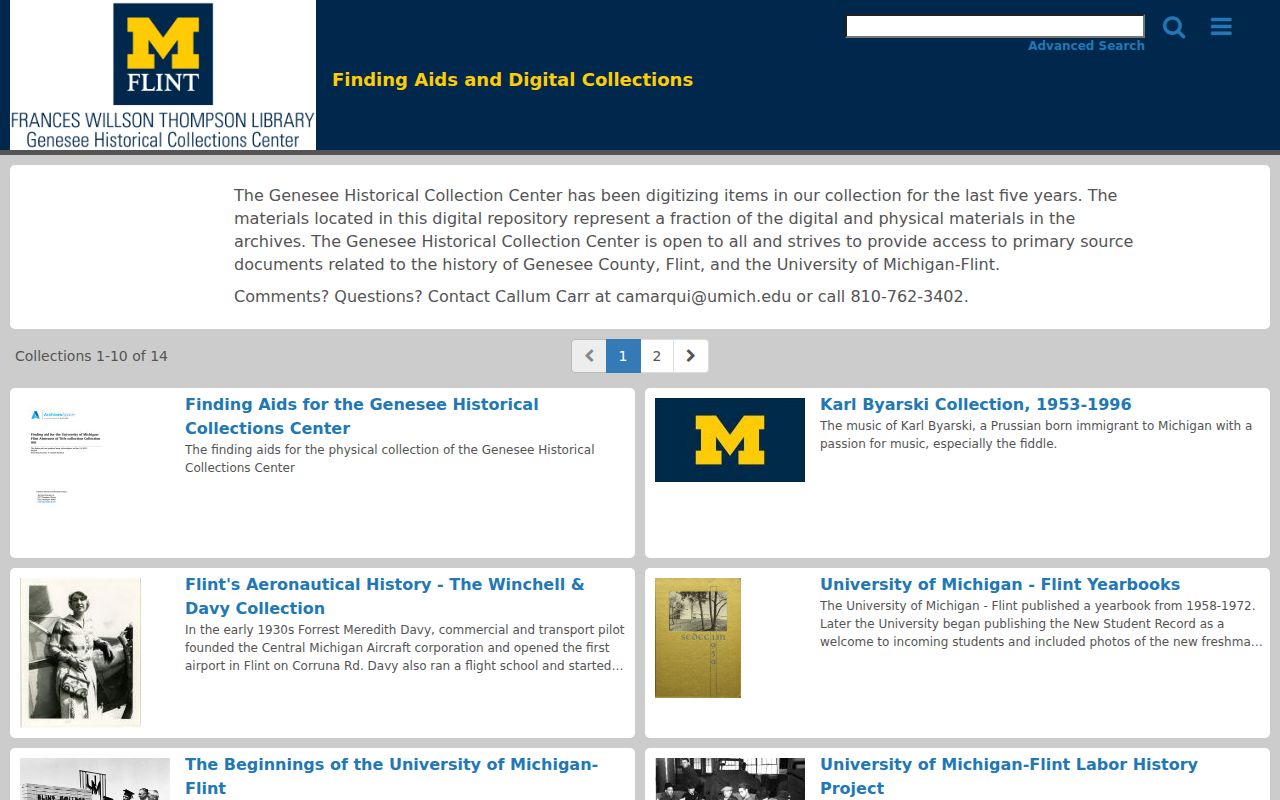
An archive item can supply context for a directory name or address, but no complete public roster of historical industrial, railroad, union, fraternal, or veterans records was verified. Request a specific collection and period instead of assuming a roster exists.
Trace Flint City Directory Households
A Flint city directory becomes more useful when each entry is preserved in sequence and paired with a census year. Begin with the address portion if the house is known, then use the name portion to check the given name, spouse, business clue, and alternate spelling. Work at two- or three-year intervals instead of assuming every year is held. Keep the printed form, volume year, page, and abbreviation key with the note.
- Find the first confirmed Flint city directory appearance by name or address, and copy the street number, spelling, apartment or room detail, and any printed status mark.
- Check the corresponding name section for a spouse, initials, business clue, and alternate spelling. Save uncertainty rather than choosing between two similar people.
- Compare a later volume two or three years away to identify a move, a changed spelling, or a new household form.
- Pair 1890s and early 1900s listings with census schedules, and pair the verified 1929 to 1932 run with the 1930 federal census. Use the 1940, 1950, and later releases when available under the federal 72-year rule.
- Test an apparent departure against a deed, assessor mailing address, tax roll, obituary, probate file, or newspaper notice before drawing a conclusion.
For an address question that moves backward through ownership and households, the Flint previous residents route puts the deed chain, directory clue, census, and map evidence in date order.
Flint City Census Clue
Flint's directory trail has a local companion that is easy to overlook. The Archives of Michigan Genesee guide lists a City of Flint census from 1927. It is not a federal decennial census and should be labeled as a city census in research notes. The same guide identifies historical voter and poll-book material, assessment rolls, cemetery files, court calendars and files, military discharges, and GAR post records. These finding-aid entries are leads, so contact the Archives before assuming a particular item is online or unrestricted.
The 1927 city census can sit between directory years as a distinct local record. It may help establish a household pattern, but it should not be merged with a federal census, township registration, or directory publication. Naming the record type and its date keeps the Flint evidence trail clear.
Flint Directory Newspaper Checks
The digitized Flint newspaper archive offers Country, State, City, Title, Date From, and Date To controls. Search a surname with a street, ward, business, or event, and try spelling variants because OCR can miss names. FPL's Genesee County Biography File also indexes Flint Journal material, county histories, and local clippings that may not surface in a web search.
The Library of Michigan guide lists Flint Daily Journal holdings for 1903 to 1935 and Flint Journal holdings for 1935 to 2018. Those are holding dates, not a complete online-issue claim. An obituary or notice can be a useful clue about relatives, a last address, or civic activity, but confirm a vital event through the appropriate custodian when a certified record is needed.
Note: A newspaper result is a lead for corroboration, particularly when its OCR text conflicts with the printed name.